

What are the chemical reactions involving Cymag in mining operations?
In the realm of mining operations, Cymag, a term often used to refer to sodium cyanide (NaCN) or potassium cyanide (KCN), plays a pivotal and well - established role. As a leading Cymag supplier, I have witnessed firsthand the significance of these chemical compounds in the extraction of precious metals. In this blog, we will delve into the chemical reactions involving Cymag in mining operations.
The Fundamental Role of Cymag in Mining
Cymag is primarily used in the gold and silver mining industries as a leaching agent. Leaching is a process that involves dissolving a desired metal from its ore. In the case of gold and silver, Cymag reacts with these metals to form soluble complexes, which can then be separated from the ore matrix.
Chemical Reactions of Sodium Cyanide in Gold Extraction
Let's first focus on Sodium Cyanide. When sodium cyanide is used in gold mining, the following series of reactions occur.
Oxidation of Gold
The first step in the process is the oxidation of gold in the presence of oxygen and water. Gold is a relatively inert metal, but in the presence of cyanide ions, it can be oxidized. The overall reaction for the oxidation of gold in a cyanide solution is given by the Elsner equation:
4Au + 8NaCN+ O₂ + 2H₂O → 4Na[Au(CN)₂]+ 4NaOH
In this reaction, gold (Au) reacts with sodium cyanide (NaCN), oxygen (O₂), and water (H₂O). The oxygen acts as an oxidizing agent, facilitating the reaction of gold with cyanide ions. The product is sodium dicyanoaurate(I) (Na[Au(CN)₂]), which is a soluble complex. This complex allows the gold to be removed from the ore matrix and enter the solution phase.
The reaction mechanism can be broken down into two half - reactions. The oxidation half - reaction for gold is:
Au + 2CN⁻→ [Au(CN)₂]⁻+ e⁻
And the reduction half - reaction for oxygen is:
O₂ + 2H₂O + 4e⁻→ 4OH⁻
By combining these two half - reactions and balancing the electrons, we get the overall Elsner equation.
Recovery of Gold from the Complex
Once the gold is in the form of the soluble dicyanoaurate(I) complex, it needs to be recovered. One common method is the use of zinc powder. The reaction between zinc and the dicyanoaurate(I) complex is as follows:
2Na[Au(CN)₂]+ Zn → 2Au+ Na₂[Zn(CN)₄]
In this reaction, zinc displaces gold from the complex, resulting in the precipitation of solid gold and the formation of sodium tetracyanozincate(II) (Na₂[Zn(CN)₄]). The solid gold can then be further purified through processes such as smelting.
Chemical Reactions of Potassium Cyanide in Silver Extraction
Potassium Cyanide is also widely used in silver mining. Similar to gold extraction, the process involves the formation of a soluble complex.
Oxidation of Silver
The reaction for the oxidation of silver in a cyanide solution is analogous to that of gold. The overall reaction is:
4Ag + 8KCN+ O₂ + 2H₂O → 4K[Ag(CN)₂]+ 4KOH
Here, silver (Ag) reacts with potassium cyanide (KCN), oxygen, and water to form potassium dicyanoargentate(I) (K[Ag(CN)₂]), which is a soluble complex. The half - reactions are similar to those in the gold extraction process. The oxidation half - reaction for silver is:
Ag + 2CN⁻→ [Ag(CN)₂]⁻+ e⁻
And the reduction half - reaction for oxygen remains the same as in the gold case.
Recovery of Silver from the Complex
To recover silver from the dicyanoargentate(I) complex, a similar displacement reaction can be used. For example, using zinc:
2K[Ag(CN)₂]+ Zn → 2Ag+ K₂[Zn(CN)₄]
Zinc displaces silver from the complex, leading to the precipitation of solid silver and the formation of potassium tetracyanozincate(II) (K₂[Zn(CN)₄]).
The Use of Sodium Cyanide Solution
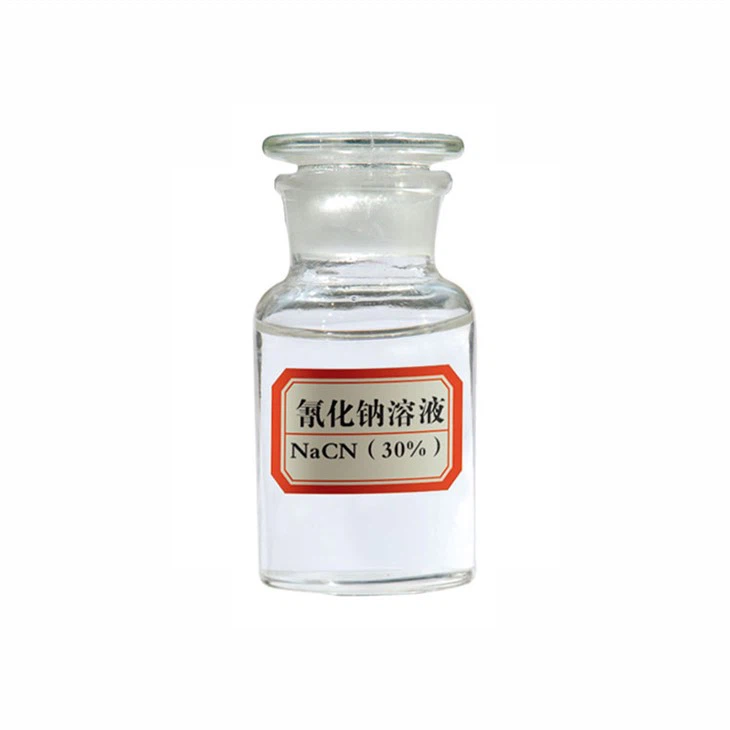
Sodium Cyanide Solution is also commonly employed in mining operations. Using a pre - made solution can simplify the process as it eliminates the need for on - site dissolution of solid sodium cyanide. The chemical reactions that occur when using a sodium cyanide solution are the same as those described above. The cyanide ions in the solution react with the precious metals to form soluble complexes, which can then be processed further for metal recovery.
Factors Affecting the Chemical Reactions
Several factors can influence the efficiency of the chemical reactions involving Cymag in mining operations.
pH of the Solution
The pH of the cyanide solution is crucial. The reactions for gold and silver extraction are most efficient in a slightly alkaline environment. If the pH is too low, hydrogen cyanide (HCN) gas may be formed, which is highly toxic. The formation of HCN can be represented by the following reaction:
H⁺+ CN⁻⇌ HCN
On the other hand, if the pH is too high, the solubility of the metal - cyanide complexes may be affected.
Concentration of Cyanide
The concentration of cyanide in the solution also plays a significant role. A higher concentration of cyanide can increase the rate of the leaching reaction. However, excessive cyanide can lead to increased costs and environmental concerns. Therefore, an optimal cyanide concentration needs to be determined based on the ore characteristics and the mining process.

Temperature
Temperature can affect the reaction rate. Generally, an increase in temperature can accelerate the chemical reactions. However, in mining operations, increasing the temperature may not always be practical due to energy costs and the potential for increased evaporation of the solution.
Environmental Considerations
While Cymag is an effective leaching agent in mining, it is also highly toxic. Cyanide can have severe environmental impacts if not properly managed. After the metal extraction process, the cyanide - containing solutions need to be treated to reduce the cyanide concentration to an acceptable level. One common treatment method is the use of alkaline chlorination. The reaction for the destruction of cyanide by chlorine in an alkaline solution is:
2CN⁻+ 5Cl₂+ 8OH⁻→ 2CO₂+ N₂+ 10Cl⁻+ 4H₂O
This reaction converts the toxic cyanide ions into relatively harmless carbon dioxide and nitrogen gas.
Conclusion
In conclusion, Cymag, whether in the form of sodium cyanide or potassium cyanide, is a vital chemical in mining operations, especially for the extraction of gold and silver. The chemical reactions involving Cymag are well - understood and form the basis of modern precious metal mining. As a Cymag supplier, I am committed to providing high - quality products and technical support to ensure the efficient and safe use of these chemicals in mining.
If you are involved in mining operations and are interested in purchasing Cymag for your projects, I invite you to contact us for further discussions. We can offer customized solutions based on your specific needs and requirements. Let's work together to optimize your mining processes and achieve the best results.
References
- Habashi, F. (1999). Principles of Extractive Metallurgy. Montreal: Laval University Press.
- Marsden, J. O., & House, C. I. (2006). The Chemistry of Gold Extraction. Society for Mining, Metallurgy, and Exploration.