

How does NaCN react with oxidizing agents?
As a supplier of NaCN, I've been deeply involved in understanding its various chemical reactions, especially those with oxidizing agents. Sodium cyanide (NaCN) is a highly reactive and important chemical compound, widely used in industries such as gold extraction, electroplating, and organic synthesis. In this blog, I'll explore how NaCN reacts with different oxidizing agents, the underlying mechanisms, and the practical implications of these reactions.
General Reactivity of NaCN
Sodium cyanide is an ionic compound consisting of sodium cations (Na⁺) and cyanide anions (CN⁻). The cyanide anion is a strong nucleophile and a reducing agent due to the presence of a lone pair of electrons on the carbon atom. When NaCN comes into contact with oxidizing agents, the cyanide anion can be oxidized, leading to a variety of products depending on the nature of the oxidizing agent and the reaction conditions.
Reactions with Different Oxidizing Agents
1. Reaction with Oxygen (O₂)
In the presence of oxygen, especially in an aqueous solution, NaCN can undergo a slow oxidation process. The reaction is complex and can be influenced by factors such as pH, temperature, and the presence of catalysts.
The overall reaction can be represented as follows:
4NaCN + 5O₂ + 2H₂O → 4NaHCO₃ + 2N₂
In this reaction, cyanide is oxidized to bicarbonate (HCO₃⁻) and nitrogen gas (N₂). The reaction is exothermic and occurs slowly under normal conditions. However, in the presence of catalysts such as copper salts, the reaction rate can be significantly increased. This reaction is of great importance in environmental remediation, as it helps to break down cyanide in wastewater.
2. Reaction with Hydrogen Peroxide (H₂O₂)
Hydrogen peroxide is a common and relatively mild oxidizing agent. When NaCN reacts with H₂O₂ in an alkaline solution, the following reaction occurs:
NaCN + H₂O₂ + H₂O → NaHCO₃ + NH₃
In this reaction, the cyanide anion is oxidized to bicarbonate, and ammonia is produced as a by - product. The reaction is often used in the treatment of cyanide - containing wastewater, as it can effectively reduce the concentration of cyanide to a safe level.
3. Reaction with Chlorine (Cl₂)
Chlorine is a strong oxidizing agent. When NaCN reacts with chlorine in an aqueous solution, the reaction is as follows:
2NaCN + 5Cl₂ + 8OH⁻ → 2CO₂ + N₂ + 10Cl⁻ + 4H₂O
In this reaction, cyanide is completely oxidized to carbon dioxide and nitrogen gas. Chlorination is a common method for the treatment of cyanide - contaminated water in industrial settings. However, it should be noted that the reaction must be carefully controlled, as excessive chlorine can produce toxic by - products such as cyanogen chloride (CNCl).
Mechanisms of Oxidation Reactions
The oxidation of cyanide by oxidizing agents typically involves a series of steps. In general, the oxidizing agent first attacks the carbon atom of the cyanide anion, breaking the C≡N triple bond. This leads to the formation of intermediate species, which are further oxidized to the final products.
For example, in the reaction with hydrogen peroxide, the peroxide anion (OOH⁻) attacks the carbon atom of the cyanide anion, forming an intermediate species. This intermediate then reacts with water to form bicarbonate and ammonia.
Practical Implications in Industries
1. Gold Extraction
In the gold extraction process, Sodium Cyanide is widely used as a leaching agent. During the extraction, oxygen in the air acts as an oxidizing agent. The reaction between NaCN, gold, and oxygen can be represented as follows:
4Au + 8NaCN + O₂ + 2H₂O → 4Na[Au(CN)₂] + 4NaOH

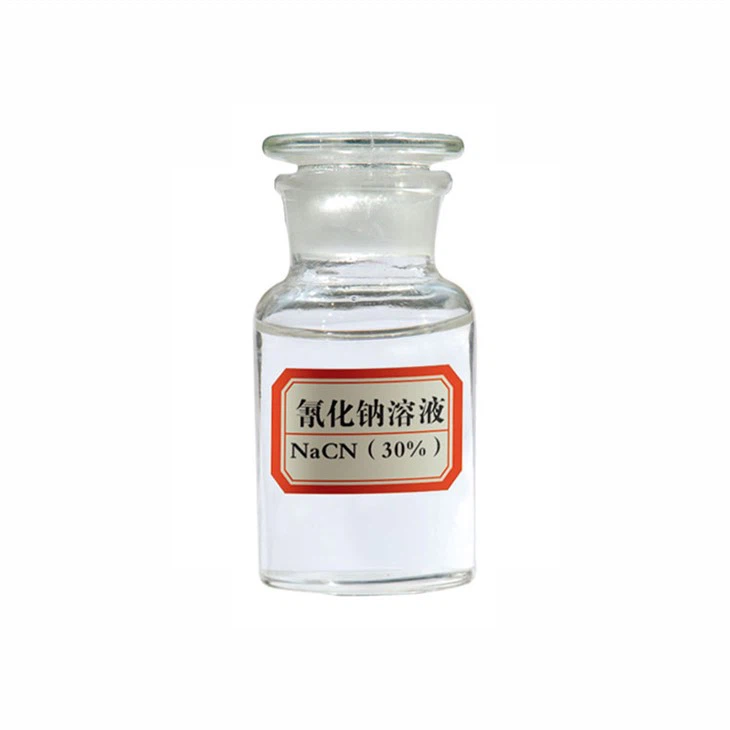
In this reaction, gold is oxidized and forms a soluble complex with cyanide ions. Understanding the reaction between NaCN and oxygen is crucial for optimizing the gold extraction process, as factors such as oxygen concentration, pH, and temperature can significantly affect the leaching efficiency.
2. Wastewater Treatment
Cyanide - containing wastewater is a major environmental concern in industries that use NaCN. Oxidation reactions with various oxidizing agents are commonly used to treat this wastewater. For example, Sodium Cyanide Solution in wastewater can be treated with hydrogen peroxide or chlorine to convert cyanide into less toxic substances.
Safety Considerations
It's important to note that NaCN is a highly toxic compound. When handling NaCN and conducting reactions with oxidizing agents, strict safety measures must be followed. This includes wearing appropriate personal protective equipment, working in a well - ventilated area, and having emergency response plans in place.
Comparison with Potassium Cyanide
Sodium Cyanide and Potassium Cyanide have similar chemical properties. Both are strong reducing agents and react with oxidizing agents in a similar manner. However, potassium cyanide is more soluble in water than sodium cyanide, which may affect the reaction rate and the solubility of the reaction products in some cases.
Conclusion
As a supplier of NaCN, I understand the importance of these oxidation reactions in various industries. Whether it's for gold extraction or wastewater treatment, a thorough understanding of how NaCN reacts with oxidizing agents is essential for optimizing processes and ensuring safety.
If you're interested in purchasing high - quality sodium cyanide for your industrial needs, I encourage you to contact me for procurement discussions. We can provide detailed information on product specifications, pricing, and delivery options to meet your specific requirements.
References
- Atkins, P. W., & de Paula, J. (2014). Physical Chemistry for the Life Sciences. Oxford University Press.
- Housecroft, C. E., & Sharpe, A. G. (2012). Inorganic Chemistry. Pearson Education.
- Shriver, D. F., & Atkins, P. W. (2010). Inorganic Chemistry. W. H. Freeman and Company.